
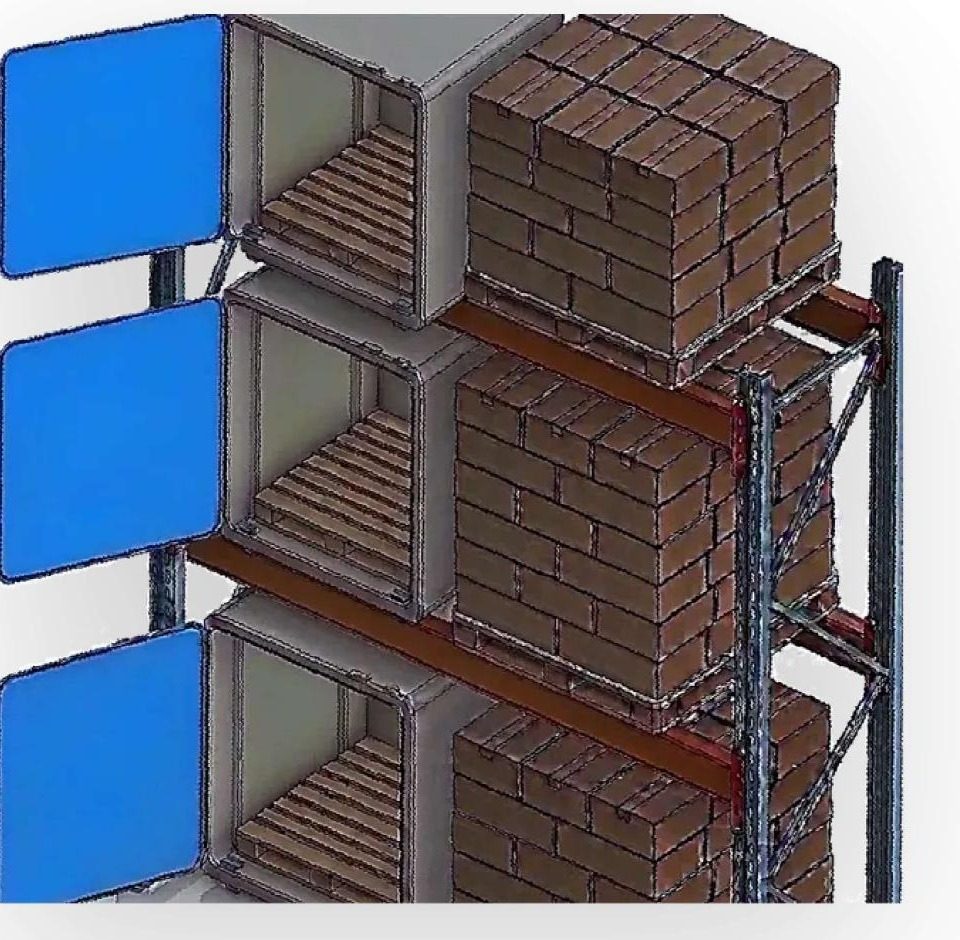
Modular controlled-atmosphere storage designed for pallet-level environmental control within existing warehouse racking, currently represented by a working prototype tested internally.
A plug-and-play modular chamber that operates within existing warehouse racks without requiring a full retrofit. By reducing oxygen to 1.5–2.5%, it creates a non-viable environment for pests while preserving product freshness and quality.
Rice, flour, noodles and other starch-based foods.
Soybeans, mung beans, lentils, corn, wheat, oats and similar commodities.
Nuts, spices, seeds, dried fruits, coffee beans and other dry food products.
Insect pests like rice weevils tolerate ambient air easily — but their metabolism is severely impaired below 3–4% oxygen, and becomes non-viable in the 1.5–2.5% range the chamber maintains.
Nitrogen's primary role inside Vorienta Chamber is atmosphere control. As an inert gas, nitrogen displaces oxygen and slows the oxidation that causes food to lose taste, texture and quality over time. The same low-oxygen environment also has a well-documented secondary effect by passively discouraging stored-product pests without adding chemicals.
Independent studies under different products and storage conditions support the principle that lower-oxygen atmospheres can slow quality deterioration. They are not Vorienta Chamber tests or shelf-life forecasts.
| Product and Conditions | Study Comparison | Reported Finding |
|---|---|---|
| Fresh filled pasta 4°C | Air: 14 days 70% N₂ / 30% CO₂: 42 days | About 3× longer mould-free period[1] |
| Rice 30°C · 150 days | Conventional vs nitrogen-modified storage | Slower changes in measured quality indicators[2] |
| Faba beans 30°C · 12 months | Air vs nitrogen flushing | Less colour darkening and tannin loss[3] |
| Peanuts 87 days · hermetic storage | Air vs anoxic nitrogen | Oxidation, free-fatty-acid increase and fungal growth were not observed under nitrogen[4] |
| Roasted and ground coffee | Air: 12 weeks Nitrogen: 52 weeks | About 4.3× longer minimum acceptability period[5] |
| Ground walnuts 20°C · 21 weeks | p-Anisidine: 0.56 in air vs 0.40 in nitrogen | About 29% lower secondary-oxidation marker[6] |
[1] Fresh filled pasta: air-packaged samples spoiled after 14 days; samples stored at 4°C under 70% N₂ / 30% CO₂ remained mould-free for 42 days. LWT, 2016
[2] Rice: nitrogen-modified storage retarded increases in fatty-acid value and amylose content and deferred decreases in enzyme activity over 150 days at 30°C. Food Chemistry: X, 2022
[3] Faba beans: nitrogen flushing reduced colour darkening and tannin losses compared with air during 12 months at 30°C. Postharvest Biology and Technology, 2008
[4] Peanuts: lipid oxidation, free-fatty-acid increase and fungal growth were not observed after 87 days of hermetic storage under anoxic nitrogen. Food Chemistry, 2022
[5] Roasted and ground coffee: air packaging remained minimally acceptable for 12 weeks versus 52 weeks for nitrogen packaging. Korean Journal of Food Science and Technology, 1999
[6] Ground walnuts: after 21 weeks at 20°C, the p-anisidine value was 0.56 under normal atmosphere versus 0.40 under nitrogen. The approximately 29% difference is calculated from the reported values. Academic Food Journal, 2021
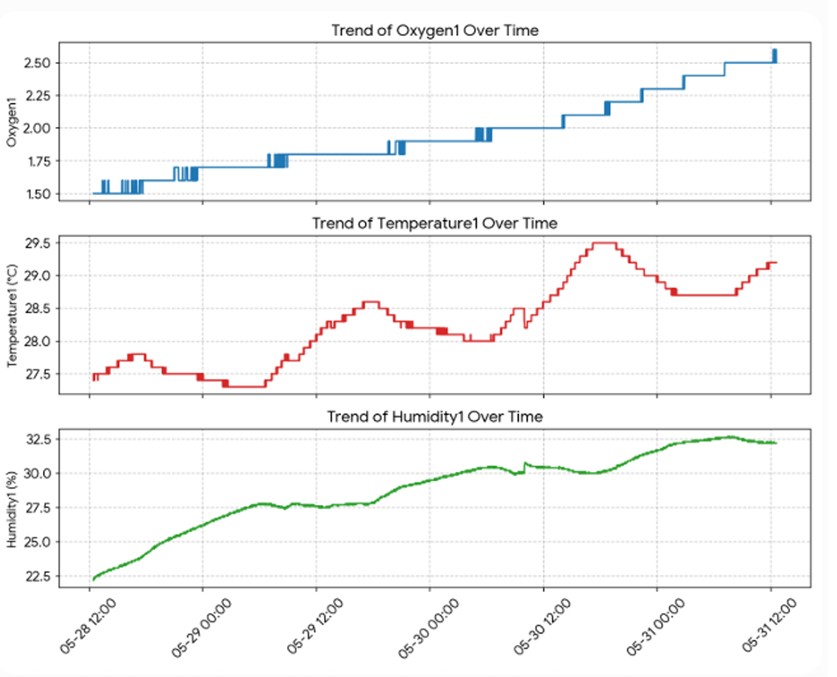
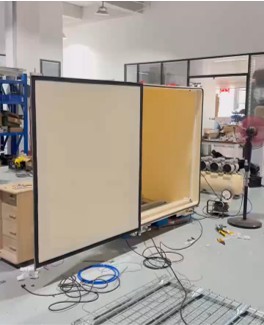
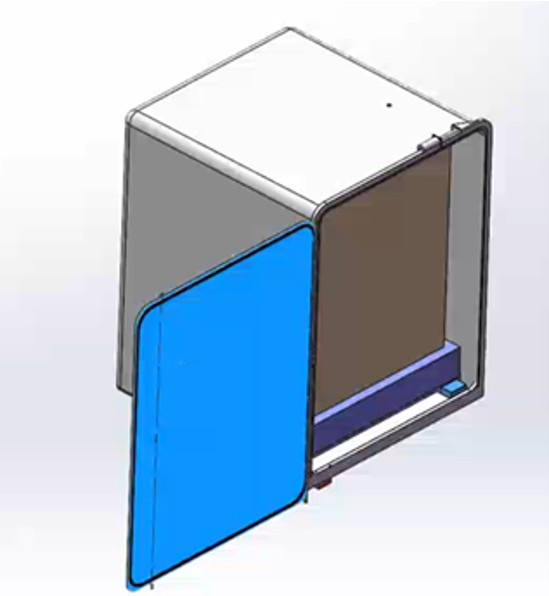
The current design is the result of an engineering development cycle. Findings from the first prototype guided the development of a single-piece, five-sided chamber that was then subjected to an internal atmosphere-control test.
The 72-hour exercise was an internal engineering test of short-duration atmosphere control. It was not third-party certification, a repeat-run validation programme or a product shelf-life trial. Longer-duration and product-specific trials remain necessary before making commercial shelf-life or payback claims.
Humidity context: Relative humidity rose from 24.3% to 32.3% during the Tianjin prototype test, an increase of 8 percentage points. For comparison, Singapore's mean annual relative humidity is around 82%.[8] During normal operation, replenishment with dry food-grade nitrogen replaces part of the chamber atmosphere while restoring the target oxygen level and is expected to help moderate humidity build-up. Dedicated humidity control was not tested separately.
[8] Source: Meteorological Service Singapore. Climate of Singapore, based on Changi Climate Station data for 1991–2020.
Modelled on a 2,000-tonne annual throughput across rice, flour, pasta, grains and other dry goods, at an illustrative S$7.45M annual retail value. Storage-related shrinkage of 2–3% can represent a meaningful recoverable value opportunity.
| Category | Share of Volume | Tonnes | Illustrative Retail Value |
|---|---|---|---|
| Rice | 30% | 600 | S$1.8M |
| Flour & wheat products | 20% | 400 | S$1.0M |
| Pasta / udon | 20% | 400 | S$1.8M |
| Grains / beans | 15% | 300 | S$1.65M |
| Others (cereals, etc.) | 15% | 300 | S$1.2M |
| Total | 100% | 2,000 | S$7.45M |
At an estimated 2–3% annual cost leakage, this portfolio erodes approximately S$149K–S$224K of value every year. Illustrative figures only; actual results vary by product mix and operations.
This scenario estimates inventory value at risk only. It excludes Chamber capital cost, installation, nitrogen consumption, energy, maintenance and operating labour, and is not a quotation, savings guarantee or payback calculation.
A 2–3% loss rate has been treated as a normal part of warehouse operations for so long that it is rarely challenged. However, that percentage is not fixed. It is a function of storage conditions. When recovered, it does not appear as new revenue. Instead, it represents inventory that has already been paid for, reaching the point of sale instead of the point of write off.
Singapore imports more than 90% of its food.[7] Pandemics, conflicts, and export restrictions over the past few years have shown that supply cannot always be replenished on demand. In this context, reducing storage losses is not simply a warehouse efficiency metric. It represents additional effective food supply recovered without importing a single extra tonne.
[7] Source: Singapore Food Agency. Singapore Food Statistics 2025. Retrieved on 7 July 2026. sfa.gov.sg
A purpose-built controlled atmosphere warehouse means committing capital for capacity you may not need for years. Vorienta Chamber and Vorienta Thermo are built to grow with your operational requirements instead.
A dedicated controlled atmosphere facility is typically sized for future capacity, financed and constructed before that capacity is actually needed. This creates a large capital outlay well ahead of the volume that justifies it.
Start with the number of chambers your current throughput needs, ten for example, and add another ten next month as demand grows. Capacity expands alongside cashflow, not ahead of it.
Choose a structured pilot path or shape a collaboration around your own technical and commercial requirements.
Pilot scope and commercial terms are agreed for each engagement. Contact Vorienta to discuss the requirements.
Tell us what you plan to store, your pallet volume and your current warehouse arrangement. We will help you assess whether a Chamber pilot is suitable.